Pre-Workout With L-Citrulline: Forms, Dose Math and Evidence

Bucked Up Original pre-workout tub in Miami flavor
Product packaging shown as an example discussed below. Check the actual container for its formula; ingredient research does not establish results for the finished product.

Affiliate disclosure: We may earn a commission from purchases through the Bucked Up links in this article.

Start with the form on the label

A pre-workout with L-citrulline should tell you which form it contains and how much is in the serving. Pure L-citrulline and citrulline malate are different label measurements. The malate portion contributes to the weight of citrulline malate, so comparing the biggest number on two tubs can be misleading.

Citrulline participates in the body’s arginine–nitric oxide pathway, which is why it appears in products marketed for blood flow and pumps. That rationale does not establish a guaranteed improvement in repetitions, muscle growth or recovery from a particular pre-workout.

What do exercise trials show?

In a randomized crossover trial in 41 men, 8 g citrulline malate improved performance in a repeated bench-press protocol and reduced reported soreness. Some participants reported stomach discomfort.

A different randomized crossover trial in 27 men tested 8 g citrulline malate during repeated leg extensions and found no benefit for the measured performance or blood-flow outcomes. Differences in exercise, participants and timing matter.

These studies support a cautious conclusion: some protocols have produced benefits, but an 8 g serving does not consistently improve every type of training. Neither study tested the Bucked Up blends below, and neither proves that a temporary pump causes long-term hypertrophy.

How to compare citrulline amounts

  • Pure L-citrulline: The listed amount refers to that ingredient.
  • Citrulline malate: Look for a declared ratio. If 6 g is genuinely a 2:1 mixture by weight, the arithmetic gives about 4 g citrulline and 2 g malate.
  • No ratio stated: Do not assume that all the listed weight is citrulline or invent an exact equivalent.
  • One versus two scoops: Keep the serving basis consistent when comparing ingredients and cost.

The 2:1 calculation is label arithmetic, not an independent assay or proof that two different products perform identically.

Where the linked Bucked Up products fit

Original Bucked Up lists 6 g citrulline malate 2:1 and 200 mg caffeine. The blend amount should not be relabeled as 6 g pure L-citrulline.

WOKE AF also lists 6 g citrulline malate 2:1, with 333 mg caffeine and other stimulants. More caffeine does not change the citrulline content into a stronger demonstrated pump effect.

If you want to avoid caffeine, check a separate caffeine-free formula on its own merits. Do not assume every product from the same brand has the same citrulline source, serving or stimulant ingredients.

Using the information sensibly

Follow the actual product directions. Do not take additional scoops of a caffeinated blend merely to reach a citrulline amount used in a study; that also increases caffeine and every other ingredient. Combining pump products can create the same problem with overlapping ingredients.

Ask a clinician or pharmacist before use if you take medication affecting blood pressure or have a relevant medical condition. Keep expectations tied to your training program, and evaluate tolerance rather than chasing visible vascularity.

Check current Bucked Up offer terms for applicable price, shipping and exclusions. No automatic percentage discount is confirmed here.

Bottom line: Compare the form, ratio and serving before the headline gram number. Citrulline is an optional training ingredient with mixed exercise results, not an essential requirement for a productive workout.

Posted in Supplements | Tagged , , , , | Comments Off on Pre-Workout With L-Citrulline: Forms, Dose Math and Evidence

Betaine Anhydrous: Mixed Performance Evidence and Practical Dose Checks

Black Ant pre-workout tub in Tropical Punch flavor
Black Ant Tropical Punch packaging illustrates the multi-ingredient product discussed below. Check its current Supplement Facts; the finished formula is not interchangeable with an isolated ingredient trial.

Disclosure: This article contains affiliate links. We may earn a commission from qualifying purchases.

What betaine anhydrous does in the body

Betaine, also called trimethylglycine, participates in methyl-group metabolism and helps cells manage osmotic stress. Those physiological roles make it interesting to sports researchers. They do not, on their own, demonstrate bigger lifts, a stronger pump or faster recovery from a supplement.

Betaine anhydrous used in sports studies should also not be confused with betaine hydrochloride products sold for digestive purposes. Check the actual ingredient name and amount instead of relying on the word “betaine” on the front of a package.

Human results are mixed

In a six-week trial in 23 trained men, 2.5 g daily was associated with selected body-composition and work-capacity improvements, but no strength advantage. The small sample and skinfold-based body-composition estimates limit what should be promised from that result.

A different randomized study compared betaine, creatine, both ingredients and placebo for ten days in untrained participants. Betaine at 2 g daily did not increase muscle phosphocreatine or add a strength/power benefit to creatine. A short trial cannot settle every longer-term question, but it challenges the assumption that the pairing is automatically synergistic.

A small cycling study reported improved sprint power after roughly 2.5 g daily for one week. An exercise-specific result should not be expanded into a guarantee of fat loss, better hydration or reduced soreness.

Read research doses as context

Several sports trials use approximately 2–2.5 g daily. That is a description of research, not a universal prescription or a reason to exceed a product’s directions. A much smaller amount inside a blend should not automatically be called a fully studied dose.

Track total intake across products. Adding multiple formulas makes it harder to judge tolerability and may duplicate caffeine, creatine or other ingredients even when your intention is simply to obtain more betaine.

How the Bucked Up options compare

Black Ant’s current full serving lists 2.5 g betaine anhydrous. It also includes creatine and caffeine, so any perceived effect cannot be attributed to betaine alone. It has not been established here as a finished-product trial equivalent.

Check the current Bucked Up offer for actual price, shipping and purchase conditions. A fixed 20% saving is not guaranteed.

Black Ant lists 5 g creatine and 300 mg caffeine per two scoops. Standalone creatine monohydrate is an alternative way to control creatine separately. Do not automatically take both full amounts or increase pre-workout servings to match a research protocol.

Bottom line

Betaine has plausible mechanisms and some encouraging findings, alongside null results. Prioritize a training plan, adequate food and sleep. If you have a medical condition, take medicines or experience symptoms, discuss supplement use with a qualified clinician.

Posted in Supplements | Tagged , , , , | Comments Off on Betaine Anhydrous: Mixed Performance Evidence and Practical Dose Checks

RipFACTOR: Human Trial Findings and Black Ant Formula Limits

Black Ant pre-workout tub in Tropical Punch flavor
Black Ant Tropical Punch packaging illustrates the multi-ingredient product discussed below. Check its current Supplement Facts; the finished formula is not interchangeable with an isolated ingredient trial.

Disclosure: This article contains affiliate links. We may earn a commission from qualifying purchases.

What is RipFACTOR?

RipFACTOR is a branded combination of Sphaeranthus indicus flower-head and Mangifera indica bark extracts. Its research is more specific than the broad promise that a “strength ingredient” automatically improves every workout. The extract preparation, daily amount, training program and study population all matter.

What human studies found

A 2023 randomized trial assigned 40 recreationally active men aged 18–40 to 650 mg daily of the standardized blend or placebo for 56 days with resistance training. Selected strength, endurance and body-composition outcomes favored supplementation.

A 2024 trial randomized 120 men; 99 completed eight weeks. It tested a water-dispersible blend at 425 or 850 mg daily with different exercise-volume comparisons. Selected strength and endurance outcomes improved. GNC funded that study, and one author worked for the ingredient supplier PLT.

These findings merit attention, but the trials were relatively short and male-only. Results cannot be assumed to apply equally to women, older adults, elite athletes or people recovering from injury. Industry involvement is relevant context, and independent replication would strengthen confidence.

Comparing the research with Black Ant

Black Ant lists 1,084 mg RipFACTOR per two-scoop serving. The listed amount alone does not establish equivalence to the materials and doses in those trials. A larger milligram number is not automatically a stronger or better-tested intervention.

The full serving also contains 5 g creatine and 300 mg caffeine. Because the product combines many ingredients, feeling more alert after a scoop does not demonstrate that RipFACTOR caused the change. The trials above do not establish a finished-product guarantee of faster recovery or a new personal record.

Do you need to add creatine?

Bucked Up Creatine Monohydrate can be used for separate dosing, but adding it automatically on top of a full Black Ant serving duplicates a common maintenance amount. Count the total first. Creatine is commonly used at 3–5 g daily, including rest days.

Do not increase caffeinated pre-workout servings to imitate a botanical study protocol. Research involving daily capsules over weeks also does not prove that occasional pre-workout use has the same effects.

A useful evidence checklist

  • Is the exact extract standardized the same way as the studied material?
  • Does the serving match the intervention, rather than just sharing a trademark?
  • Were relevant outcomes measured against placebo?
  • Are benefits replicated in people who resemble the intended user?

Ask a clinician about botanical supplements if you take medication or have a medical condition. Keep food, sleep and progressive training central; no blend removes the need to recover between sessions.

View current Bucked Up terms. Check price, shipping and any subscription option. No automatic discount or individual performance result is guaranteed.

Posted in Supplements | Tagged , , , , | Comments Off on RipFACTOR: Human Trial Findings and Black Ant Formula Limits

CreaSol SSAT: Tyrosol, the 2026 Trial and Claims That Need Caution

Black Ant pre-workout tub in Tropical Punch flavor
Black Ant Tropical Punch packaging illustrates the multi-ingredient product discussed below. Check its current Supplement Facts; the finished formula is not interchangeable with an isolated ingredient trial.

Disclosure: This article contains affiliate links. We may earn a commission from qualifying purchases.

First, identify the ingredient correctly

CreaSol SSAT is a branded stabilized form of tyrosol, a phenolic compound. It is a separate ingredient used alongside creatine. Describing it as creatine crystals with an improved delivery coating, or as another form of creatine, misidentifies what the manufacturer lists.

Similarly, Six Point Creatine is a multi-form creatine product. Its current formula does not list CreaSol SSAT. A photo or link to that product cannot serve as evidence that it contains tyrosol.

There is a human trial

A randomized trial published in May 2026 compared tyrosol, creatine, their combination and placebo. Fifty adults were randomized and 48 completed four weeks. The combination used 500 mg tyrosol plus 3 g creatine daily.

Selected bench-press outcomes favored the combination. Several other performance and cognitive outcomes did not show significant effects. This is an interesting early result from a small, short study, with limitations including incomplete control of training, diet and sleep.

The reported findings do not establish improved intestinal absorption, faster muscle-creatine saturation or easier digestion. Three gastrointestinal events occurred in the combination group, including nausea/bloating associated with one withdrawal. Those events do not establish causation, but they do rule out presenting this trial as proof of fewer stomach problems.

What Black Ant actually lists

Black Ant lists 500 mg CreaSol SSAT separately from 5 g creatine monohydrate per full two-scoop serving. That serving also supplies 300 mg caffeine. The commercial multi-ingredient formula was not the intervention tested in the tyrosol trial.

Standalone creatine monohydrate lets you manage creatine independently. A common maintenance routine is 3–5 g daily. Loading is optional even without tyrosol, so “no loading needed” is not evidence that an enhancer is necessary or superior.

What would support the stronger claims?

For a claim about absorption or muscle saturation, look for direct human measurements and an appropriate equal-dose comparison. For fewer digestive symptoms, look for prespecified tolerability outcomes in enough participants. A patent, proposed mechanism or improved exercise result cannot answer all three questions.

Do not interpret more soluble powder as automatically more effective muscle delivery. Mixing behavior in a shaker and measurable uptake into tissue are different endpoints.

How to compare the options

Review Black Ant’s label if you want its combined ingredients, or creatine monohydrate for a simpler daily routine. Count existing creatine and caffeine before combining products. Never increase caffeinated servings to chase a loading target or a research dose.

Check the current Bucked Up offer. Confirm checkout price, shipping and any subscription terms; an automatic 20% reduction is not assured.

Bottom line: CreaSol SSAT has preliminary combination-trial evidence. That is narrower than proof of faster absorption, less bloating or guaranteed strength gains.

Posted in Ingredients, Pre Workout, Supplements | Tagged , , , , | Comments Off on CreaSol SSAT: Tyrosol, the 2026 Trial and Claims That Need Caution

Huge Wrecked Pre-Workout: Current U.S. Formula and Serving Guide

Huge Supplements Wrecked pre-workout tub in Blue Razz flavor
Manufacturer product photo. Match the exact version, flavor and Supplement Facts on the package you are buying.

Affiliate disclosure: We may earn a commission from purchases through the Bucked Up links in this article.

Wrecked is a specific Huge Supplements product

“Huge Wrecked” refers to Wrecked pre-workout from Huge Supplements. It is not a generic name for an intense workout supplement. This guide covers the current U.S. Wrecked formula. Wrecked Enraged is a separate product, and labels sold in other markets or older containers can differ.

This is a label-based guide. We have not tested its taste, how it feels or whether it improves a particular workout.

One scoop and two scoops are different servings

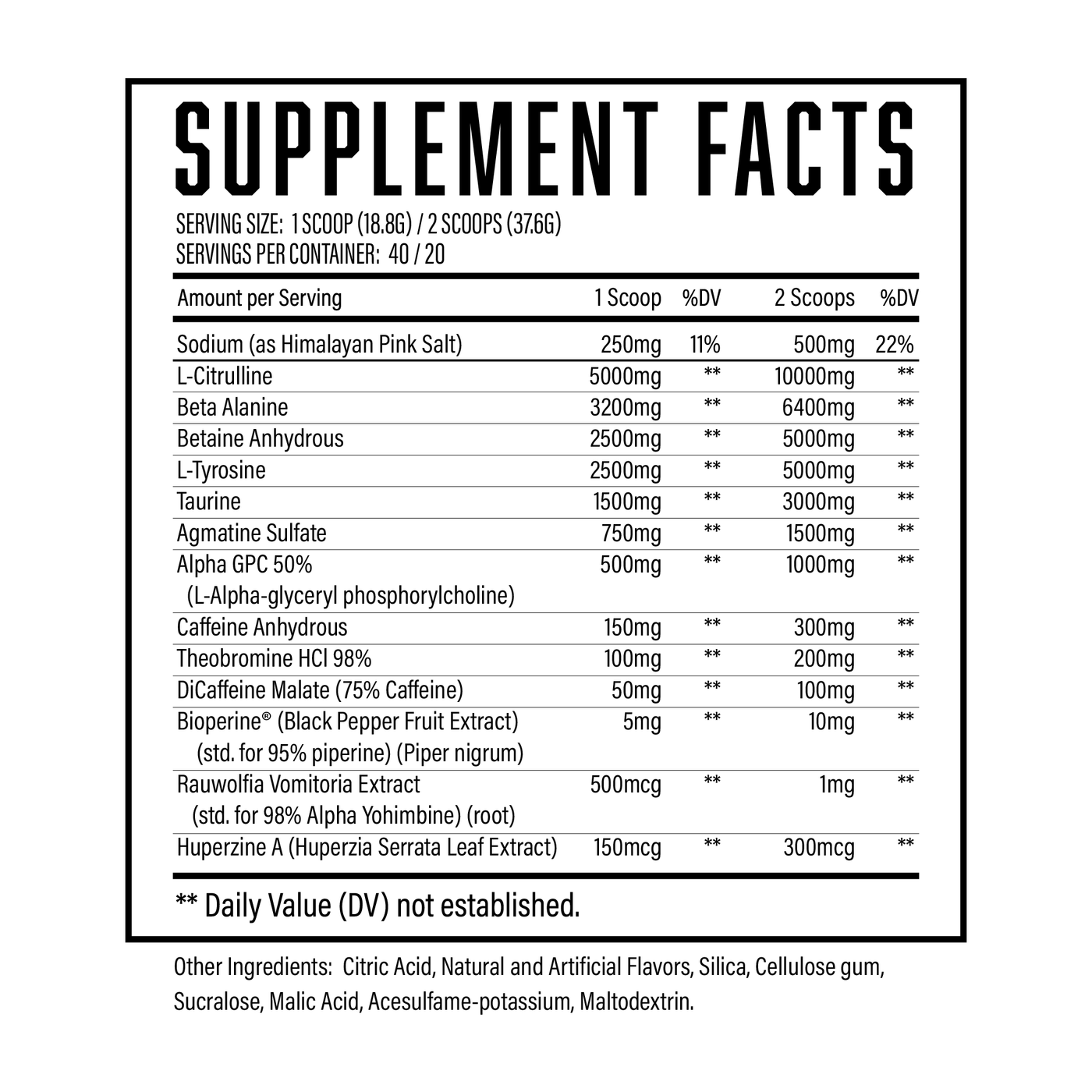
The manufacturer’s current Supplement Facts image shows one 18.8 g scoop or two 37.6 g scoops, yielding 40 or 20 servings per container respectively. The two-scoop column includes:

  • 10 g L-citrulline and 6.4 g beta-alanine
  • 5 g betaine anhydrous and 5 g L-tyrosine
  • 3 g taurine and 1.5 g agmatine sulfate
  • 1 g Alpha-GPC 50%
  • 300 mg caffeine anhydrous plus 100 mg dicaffeine malate at 75% caffeine
  • 200 mg theobromine HCl 98% and 1 mg Rauwolfia vomitoria extract standardized to 98% alpha-yohimbine

The caffeine calculation is 300 mg plus 75 mg, or 375 mg per two scoops. One scoop supplies half those listed amounts, including approximately 187.5 mg caffeine. The full weight of dicaffeine malate should not be counted as pure caffeine.

The caffeine number is only part of the assessment

Theobromine and the Rauwolfia ingredient also belong in a review of the formula. Feeling accustomed to coffee does not establish tolerance to the complete mixture. Avoid combining it with another stimulant pre-workout, and have a clinician or pharmacist review the full label if you take medications or have a medical condition.

Late timing can also matter. In a controlled experiment, 400 mg caffeine disrupted sleep even when taken six hours before bed. That is a different dose from Wrecked’s 375 mg and does not predict an individual response, but it argues against treating strong stimulation as a free benefit.

Wrecked versus Enraged and the linked alternatives

Huge sells Wrecked Enraged separately, with a different stimulant-focused formula. Do not use Enraged’s label to explain the standard Wrecked tub pictured here.

Mother Bucker lists 400 mg total caffeine per serving. The Mother Bucker product page breaks that into 300 mg anhydrous plus 100 mg delayed-release caffeine. That is a label difference, not proof of greater strength gains or a better experience.

WOKE AF lists 333 mg caffeine plus additional stimulants. Read WOKE AF’s full formula and warnings before treating its lower caffeine number as a lower-risk substitute. These products have different ingredient combinations.

Practical buying checks

Use the directions on your actual container, confirm the market and version, and calculate cost per serving at the serving size you intend to use. Never increase scoops simply to chase a stronger sensation or match an isolated research dose.

View current Bucked Up offers for price, shipping and promotion terms. No specific percentage saving is verified here.

Bottom line: Current U.S. Wrecked has a 375 mg two-scoop caffeine total and additional active stimulants. Accurate serving and version identification matter more than claims about the “strongest” pre-workout.

Posted in Supplements | Tagged , , , , | Comments Off on Huge Wrecked Pre-Workout: Current U.S. Formula and Serving Guide

ATP Energy Production: How Exercise Systems and Creatine Fit Together

Bucked Up Essentials Creatine Monohydrate unflavored tub
Product packaging shown as an example discussed below. Check the actual container for its formula; ingredient research does not establish results for the finished product.

Disclosure: This article contains affiliate links. We may earn a commission from qualifying purchases.

ATP powers muscle contraction

Adenosine triphosphate, or ATP, supplies usable energy for muscle contraction. Because the immediately available pool is small, working muscle continually regenerates it. “More energy” on a supplement label can refer to alertness, metabolism or exercise performance; those are not the same measurement.

Three systems work together

  • Phosphagen system: phosphocreatine donates phosphate to help rapidly rebuild ATP during demanding efforts.
  • Glycolysis: carbohydrate breakdown contributes ATP, especially when work requires energy quickly.
  • Oxidative metabolism: mitochondria use oxygen to sustain ATP production and help restore phosphocreatine between efforts.

These systems overlap from the start of exercise. They do not switch on and off at rigid ten-second or two-minute boundaries. Their relative contributions change with intensity, duration, recovery intervals and training status.

Where creatine fits

Creatine supplementation can increase muscle creatine availability. A human phosphocreatine-resynthesis study found variable responses, illustrating why the mechanism should not become a promise of identical results. A separate repeated resistance-exercise trial reported improved performance after loading.

Neither finding means that one scoop immediately supplies a heavier lift. Skill, muscle size, fatigue, nutrition and programming also affect force production. Rest between sets remains important even when you use creatine.

Choose the delivery format carefully

Bucked Up Creatine Monohydrate provides an option for separate dosing. Check its serving information when comparing amounts and cost. A common daily maintenance routine uses 3–5 g monohydrate; loading is optional.

Black Ant combines creatine with stimulants and other ingredients. Two scoops list 5 g creatine and 300 mg caffeine. Check the current formula rather than assuming every pre-workout contains creatine or provides the same amount.

Count that included creatine before adding another powder. Do not multiply caffeinated servings for a loading phase. Caffeine-related alertness is not a direct reading of muscle ATP or proof of better recovery.

Put the mechanism into practice

Use rest intervals that preserve the quality required by your session. Fuel demanding training with an appropriate diet, maintain hydration and build conditioning progressively. A supplement cannot replace these choices. Seek medical guidance before creatine if you have kidney disease or another relevant health concern.

Check current Bucked Up offers for actual checkout pricing and terms; automatic 20% savings are not guaranteed.

The linked sample kit was listed on October 11, 2026 as five samples, a shirt and shaker for US$9.99, for new customers and limited to one per household. Confirm shipping, tax and availability. Samples can help assess taste and tolerability, not establish long-term training effects.

For label comparisons, see standalone creatine and Black Ant. Choose based on your routine and stimulant needs rather than a promise to “boost ATP” instantly.

Posted in Supplements | Tagged , , , , | Comments Off on ATP Energy Production: How Exercise Systems and Creatine Fit Together

RYSE SunnyD Loaded Pre: Caffeine, Ingredients and Label Comparisons

RYSE Loaded Pre pre-workout tub in SunnyD Tangy Original flavor
Product packaging shown as an example discussed below. Check the actual container for its formula; ingredient research does not establish results for the finished product.

Affiliate disclosure: We may earn a commission from purchases through the Bucked Up links in this article.

Which RYSE SunnyD formula is this?

SunnyD Tangy Original is a flavor of RYSE Loaded Pre powder. This guide covers the SunnyD Loaded Pre variant currently shown by RYSE, rather than Blackout, Godzilla or a canned energy drink. A flavor partnership alone does not identify all the ingredients in a product.

We have not tested its taste, sweetness or mixability. The useful starting point is the flavor-specific label, particularly because the general Loaded Pre marketing text and the SunnyD panel do not fully agree.

The inspected SunnyD Supplement Facts

The SunnyD panel lists one 14 g scoop and 30 servings per container, with:

  • 4,500 mg L-citrulline
  • 3,500 mg beta-alanine
  • 500 mg VitaCholine choline bitartrate, supplying 200 mg choline
  • 300 mg caffeine blend: 270 mg anhydrous and 30 mg delayed-release caffeine
  • 100 mg theobromine and 50 mg L-theanine

The general page copy mentions 120 mg ZumXR and Thinkamine, which do not match this flavor’s posted panel. This article follows the SunnyD-specific panel. Check your physical tub and ask the manufacturer about any mismatch before using it.

Read the amounts correctly

The two caffeine portions add to 300 mg; the delayed-release portion is included in that total. Likewise, 500 mg choline bitartrate and its 200 mg choline yield describe the same ingredient in different ways. They should not be added together.

Release timing does not establish that a product will be crash-free or suitable near bedtime. A controlled study found that 400 mg caffeine affected sleep even six hours before bed. It used a different dose from this formula, but underlines why evening timing matters.

Beta-alanine research also needs context. In a primary supplementation study, muscle carnosine and cycling capacity changed after weeks of use. A tingling sensation from one serving does not establish an immediate endurance improvement.

How the linked alternatives compare

Original Bucked Up lists 200 mg caffeine, compared with SunnyD Loaded Pre’s 300 mg. Original’s 6 g citrulline malate should not be treated as 6 g pure L-citrulline when comparing it with RYSE’s 4.5 g.

WOKE AF lists 333 mg caffeine plus other stimulants. A nearby caffeine number does not make the overall stimulant formulas interchangeable. These differences describe the labels; they do not establish a winner for pumps, strength or focus.

Before ordering or using a serving

  • Match the product name, flavor and Supplement Facts to the actual seller listing.
  • Follow that container’s directions and maximum serving guidance.
  • Avoid combining stimulant pre-workouts and account for other caffeine sources.
  • Ask a clinician or pharmacist about medications, medical conditions, pregnancy or nursing.

Check the Bucked Up sampler offer for current contents and shipping terms if you want a smaller purchase. Sample availability and included items can change.

Review current Bucked Up promotions at checkout. A specific automatic discount is not guaranteed here.

Bottom line: Use the exact SunnyD Loaded Pre panel to compare formulas. Flavor branding, a larger number on a tub or a stronger stimulant serving cannot substitute for that check.

Posted in Supplements | Tagged , , , , | Comments Off on RYSE SunnyD Loaded Pre: Caffeine, Ingredients and Label Comparisons

Creatine for Recovery: What Human Trials Do and Do Not Show

Bucked Up Essentials Creatine Monohydrate unflavored tub
Product packaging shown as an example discussed below. Check the actual container for its formula; ingredient research does not establish results for the finished product.

Disclosure: This article contains affiliate links. We may earn a commission from qualifying purchases.

What do you mean by recovery?

Recovery can mean restoring energy between sets, regaining force after a demanding workout, feeling less sore or healing an injury. Those outcomes are related but not interchangeable. Creatine’s role in rapid energy recycling does not by itself prove faster tissue repair.

Creatine monohydrate has useful performance applications, particularly alongside resistance training. The more specific claim that it reliably prevents soreness or shortens the time needed between all workouts deserves a separate look at human trials.

Positive findings and important limits

A 2024 randomized trial in 20 healthy men used supplementation for 28 days before eccentric elbow exercise. Selected strength, movement and swelling-related recovery measures favored creatine. This was a small, controlled muscle-damage experiment, not a test of normal training weeks or a finished pre-workout.

Other findings differ. A 2007 trial in 22 weight-trained men found no recovery advantage after a high-volume squat challenge, including no between-group difference in soreness. Different muscles, exercise protocols and supplementation periods can produce different results.

Together, these studies justify cautious interest. They do not establish that every user will feel less sore, that recovery improves within a fixed number of days, or that a more expensive creatine stack works better.

A practical approach

If you choose creatine for training support, use a consistent routine rather than taking large amounts only when sore. A common maintenance dose is 3–5 g daily. An optional loading phase uses about 20 g daily in divided doses for 5–7 days before maintenance.

Keep adequate food, protein, sleep and appropriate training progression at the center of your plan. Track whether you can repeat planned sessions with good technique. Persistent pain or loss of function calls for assessment, not an assumption that another supplement will fix it.

What the linked products supply

Bucked Up Creatine Monohydrate is one way to dose creatine separately. No product-specific trial here establishes that it repairs muscle faster than an equivalent monohydrate powder.

Black Ant lists 5 g creatine and 300 mg caffeine per two scoops. That does not make it a proven recovery treatment. Count its creatine toward your daily total, follow the label, and avoid taking additional caffeinated servings to reach a target.

Ask a clinician before supplementation if you have kidney disease or relevant medical concerns. A caffeinated product close to bedtime may also work against a sleep-focused recovery plan.

Check the current Bucked Up offer. Verify price, shipping and purchase terms; no automatic discount or faster recovery is guaranteed.

Bottom line: creatine can be considered for training support. Evidence for specific recovery outcomes remains dependent on the situation and should not be turned into a promise of reduced downtime.

Posted in Ingredients, Recovery, Supplements | Tagged , , , , | Comments Off on Creatine for Recovery: What Human Trials Do and Do Not Show

Creatine for Muscle Mass: Training Benefits Versus Early Water Weight

Bucked Up Essentials Creatine Monohydrate unflavored tub
Product packaging shown as an example discussed below. Check the actual container for its formula; ingredient research does not establish results for the finished product.

Disclosure: This article contains affiliate links. We may earn a commission from qualifying purchases.

Muscle growth and scale weight are different

Creatine monohydrate can complement resistance training when the goal is muscle growth. Its best-known role is helping maintain the phosphocreatine system used during demanding efforts. That may support training quality, but taking a scoop does not guarantee hypertrophy.

A fast increase on the scale can include water. Measurements described as lean mass also include water and other non-fat tissues, so an increase in lean mass should not automatically be described as the same amount of new muscle protein.

Evidence beyond the bathroom scale

A 12-week randomized trial in 19 resistance-trained men measured muscle fibers as well as strength and body composition. Selected fiber-size gains were greater with creatine than placebo. That provides more direct support for training-related muscle adaptation than scale weight alone.

The study was small, used a structured training program and did not test Bucked Up products. It cannot tell you how much muscle you will gain, whether an advanced creatine blend is better, or whether adding more products speeds the process.

Build a routine you can keep

  • Follow a progressive resistance-training plan suited to your experience and recovery.
  • Eat enough food and protein for your goal; a supplement cannot compensate for a consistently inadequate diet.
  • Use comparable training logs, measurements and photos across weeks. Keep lighting and conditions consistent when judging visual changes.
  • If using creatine, a common daily maintenance amount is 3–5 g. Loading is optional.

Exact supplement timing is less important than following the routine. There is no need to add a caffeinated workout every day merely to take creatine.

Choose by the label

Bucked Up Creatine Monohydrate lists 5 g per scoop. The product page can help you compare serving size and cost. This is an option for separate dosing, not evidence that the brand produces more growth than another equivalent monohydrate product.

Black Ant includes creatine in a caffeinated blend: two scoops list 5 g creatine and 300 mg caffeine. Review the current formula and directions before combining it with another powder.

A full serving already covers a common maintenance amount. Automatically adding another full creatine serving after training is unnecessary for that plan. Never exceed the pre-workout directions to obtain more creatine.

Tolerability and expectations

Water-weight changes and stomach discomfort can occur. Ask a clinician about use if you have kidney disease or relevant medical concerns. Track strength and training tolerance without treating soreness, tingling or a temporary pump as proof of new muscle.

View the current Bucked Up offer. Check final pricing, delivery charges and recurring-order terms; a 20% discount is not guaranteed.

Takeaway: creatine may add to the results of a suitable training program. Judge progress over time and distinguish muscle adaptation from short-term fluid changes.

Posted in Ingredients, Supplements | Tagged , , , , | Comments Off on Creatine for Muscle Mass: Training Benefits Versus Early Water Weight

Creatine for Strength: Evidence, Daily Dosing and Realistic Expectations

Bucked Up Essentials Creatine Monohydrate unflavored tub
Product packaging shown as an example discussed below. Check the actual container for its formula; ingredient research does not establish results for the finished product.

Disclosure: This article contains affiliate links. We may earn a commission from qualifying purchases.

How creatine relates to strength

Muscle uses phosphocreatine to help regenerate ATP during demanding contractions. Supplementing with creatine monohydrate can increase the available creatine pool. This makes it relevant to repeated high-intensity work and resistance training, although it does not guarantee extra weight on every lift.

Feeling stimulated during a workout and building strength across a training block are different outcomes. Creatine does not need to produce a noticeable sensation to affect muscle stores, and a strong pre-workout sensation does not measure that effect.

What a training trial can tell us

In a 12-week trial involving 19 trained men, the creatine group made greater bench-press and squat gains than placebo while following a resistance-training program. The trial supports a possible additional benefit alongside training. Its small, male sample cannot predict an individual lifter’s improvement or establish a benefit for a particular commercial blend.

Keep exercise selection, technique and progression consistent enough to evaluate your own training. Compare several weeks of logged sets rather than attributing a single good session to a supplement. Sleep, food intake, practice and rest intervals can also change performance.

Use a repeatable dose

A common approach is 3–5 g creatine monohydrate daily, including rest days. Loading is optional: approximately 20 g per day in divided portions for 5–7 days, then maintenance. The slower daily approach avoids the need for a high starting intake.

Bucked Up Creatine Monohydrate lists 5 g per scoop. Check the current product label for the exact version you buy. Ingredient research is not a certification of purity; verify any independent testing claim in the certifier’s directory rather than relying on terms such as “NSF-style.”

Account for combination products

Black Ant is a multi-ingredient option. Its full two-scoop serving lists 5 g creatine and 300 mg caffeine. The manufacturer’s directions and your caffeine tolerance matter independently of the creatine amount.

Do not use extra caffeinated scoops to reach a creatine target, and do not automatically add standalone creatine when your pre-workout already supplies your planned daily amount. A separate powder can make rest-day dosing simpler without requiring caffeine.

Make the decision fit your situation

Early weight gain and stomach discomfort are possible. People with kidney disease or relevant medical concerns should ask their clinician before starting. Competitive athletes should consider independently batch-tested products, recognizing that testing reduces rather than eliminates risk.

Check current Bucked Up offers. Confirm the checkout total and any subscription choice. No fixed discount or performance outcome is promised.

Bottom line: creatine is a reasonable option to consider alongside progressive training. A consistent plan and realistic expectations are more useful than a deadline for guaranteed gains.

Posted in Supplements | Tagged , , , , | Comments Off on Creatine for Strength: Evidence, Daily Dosing and Realistic Expectations